Technology should give us more of our lives back
For years, technology has helped us connect to more people, information, and things demanding our attention. But it hasn’t always helped us feel more present and supported in our own lives.
We think the next chapter should work differently: technology that understands what matters to you, helps you follow through, and leaves more room for the people you love. Thanks to AI, this is now possible.
Legend is an ambient assistant that unlocks your full potential. It is a wearable pendant that stays present with you, quietly observing what you say and hear throughout the day so it can remember the context you’d otherwise lose. It then proactively turns those follow-ups into follow-through, while you get to stay in the moment.
Life comes at you fast and as much as you’d like you can’t fit it neatly inside of apps. Plans are made in conversation. Ideas arrive on a walk. Commitments come up between meetings.
Today, if you want AI to help with your life, you have to cram all that context into a prompt yourself. A task so complicated we gave it a discipline: prompt engineering.
Legend is designed to bring that everyday context into AI automatically, so you can ask a simple question and get help that actually understands your situation without having to explain your life from scratch.
The most important data source for AI will be your real life. Context is the missing piece of the agent stack, and the largest untapped source of it is the physical world: what was said, what was promised, who matters, what is still open.
With Legend, people will bring their own context to AI.
We're repeat founders building at the intersection of voice AI and consumer scale. Saba was on the founding team of Orai, an AI speech coach that reached 300,000+ users. Zach co-founded Fieldy, a small, hands-free wearable AI notetaker that transcribes audio, reaching $5M in annualized revenue. AK exited an award winning mobile app development studio and later took senior growth roles at Google & Meta managing a $1B+ growth portfolio.
The pendant is already in the hands of trusted testers. We’re raising $4M. Power users use it 9.3 hours a day. We will get Legend into the hands of 1M people within the next 5 years.
— Saba, Zach, & AK
Why ambient
Ambient AI stays present in the room, hears the context of a day, and helps without needing a prompt.

Every interface wave made computers more human: point and click, tap and swipe, ask and answer, and now presence. Speech understanding and on-device processing finally make presence practical, at the moment agents are ready to act but lack real life context.
Where we start
We start with people who have the problem the hardest. Our first major milestone is to get this in the hands of a million people with ADHD. Around 140–366 million adults live with ADHD worldwide[1]. In the US alone, 15.5 million adults have a current ADHD diagnosis[2], and 6.2 million of them live in households earning at least four times the federal poverty line[2], which can comfortably afford a solution to their challenges.
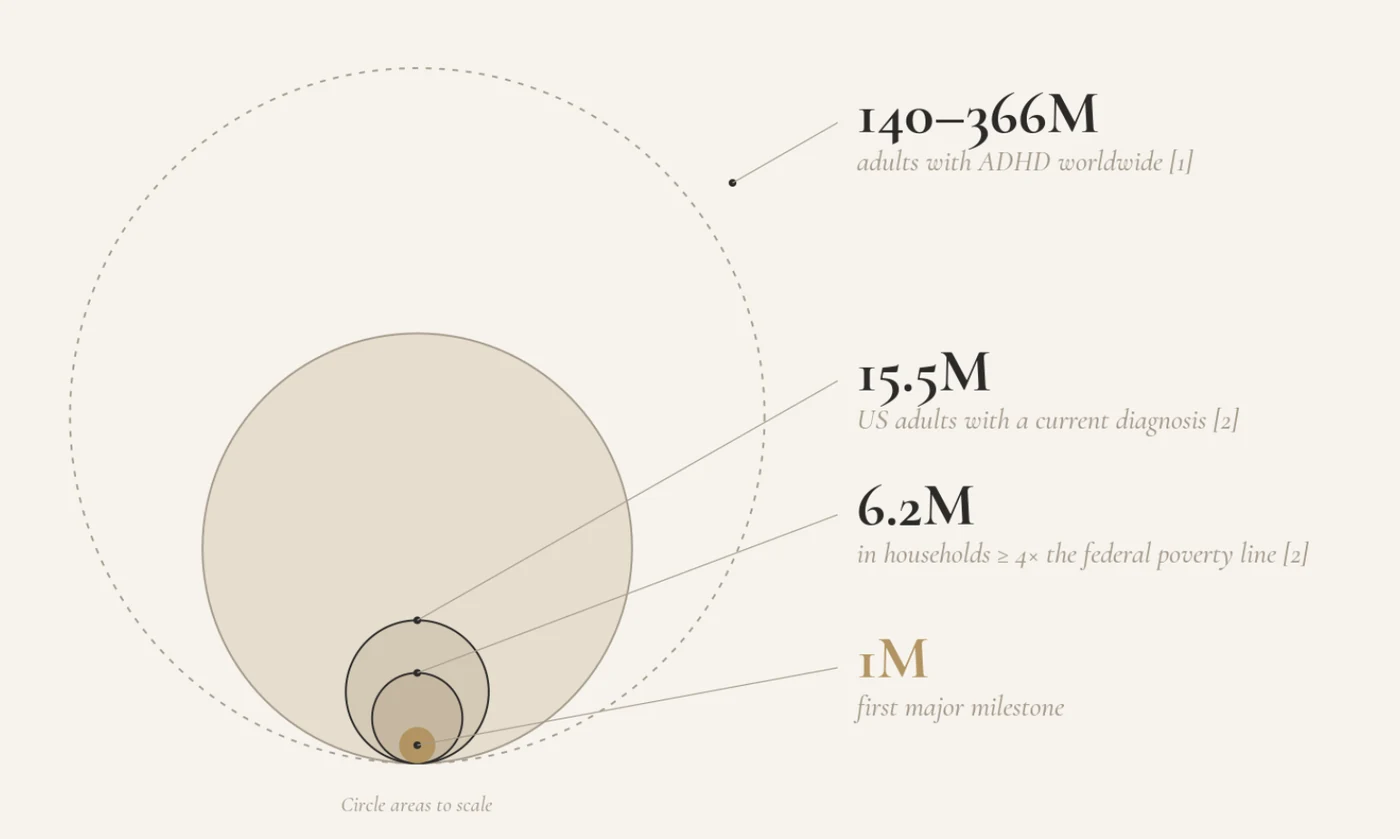
Eventually we expand to executive-function strugglers (2-3x the wedge), overloaded knowledge workers (1.14B worldwide) and then everyone.
The business
Legend is $499 per year, flat. The device is free, usage is unlimited, and hardware upgrades are free. The subscription pays for an ever-present chief of staff for your life. The price point is premium to match the impact it has. Context retention and proactive task execution is how people unlock that value.
Premium is a product decision, not a pricing tactic. People pay $300 for Oura or Whoop for sleep and strain. Legend holds commitments, remembers what matters for professional and social life, and takes work off the plate. Locking in at premium lets us deliver the best possible product, without rationing quality. Zach ran this experiment at Fieldy: $99 upfront and $179 a year. Staying profitable meant using worse models and components that were just good enough, and the experience suffered.
The device BOM is approaching $100 and total AI cost per user is higher than $100. At $499, the target 60 percent gross margin is a scale story: AI costs fall by orders of magnitude as they cross thresholds, and when they do, we become more profitable. iPhone entered at a multiple, proved it needed to exist, and phones are $1,000 forever.
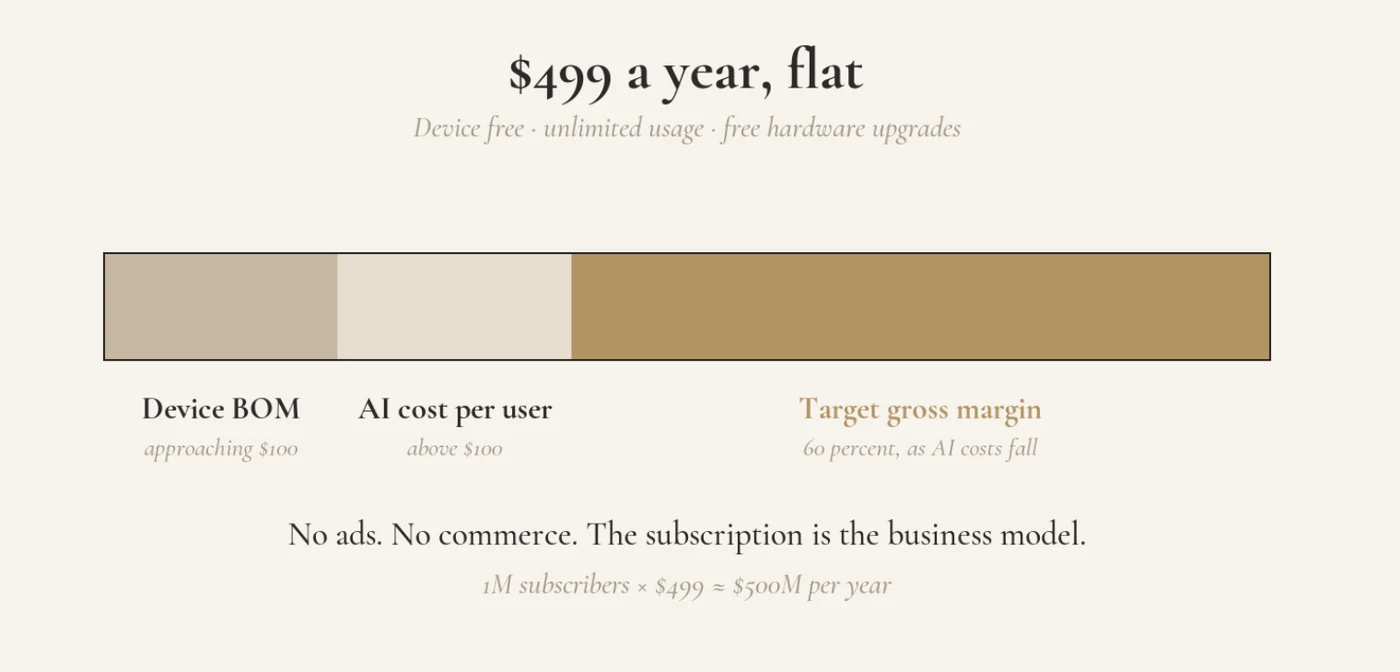
At 1 million subscribers at $499, Legend is earning $500 million per year. The renewal is earned. To encourage it, they get the latest hardware, and can donate the old one to a friend or family member, or send it back.
What we will not do is subsidize the subscription with commerce or ads. This type of revenue would make a sensitive product feel manipulated, with your most personal asset, your conversations, as the inventory. The subscription is the business model, and trust is what keeps the pendant out of the drawer.
Even a wearer who pays $0 is valuable because wearing drives word of mouth and the network effect. The goal is ubiquity: something for everyone, fashion forward.
The form
The form is jewelry. Objects of value. Something people already choose to wear all day with no new behavior to learn. The first product is a pendant. Sitting at the heart of where the conversation happens.

Ultimately, form will be up to personal preference and we’ll continue to expand our product line to meet the culture’s demands.
The retention mechanism behind the wear time is to make something that keeps being worn. Power users wear it the entire day, because they don’t have to remember to pull it out of a drawer.
The distribution mechanism comes from word of mouth, driven by a fashion statement.
Private by design
This only works if the trust model is structural, not promised.
The pendant's chip is PSA Certified Level 3, the highest security tier for a wearable device. Data at rest sits under AES-256 envelope encryption, which makes deletion clean. Audio is not stored after processing.
Private zones are excluded at index time. Access is per agent, granted through OAuth with explicit scopes. Every grant is revocable. Every query is written to an audit log the wearer can inspect. The model providers who process requests do so under zero data retention, with every request anonymized before it leaves. And a wearer can sign in through an Apple private relay, so even the account cannot be traced back to them. The wearer is the admin of their own context.
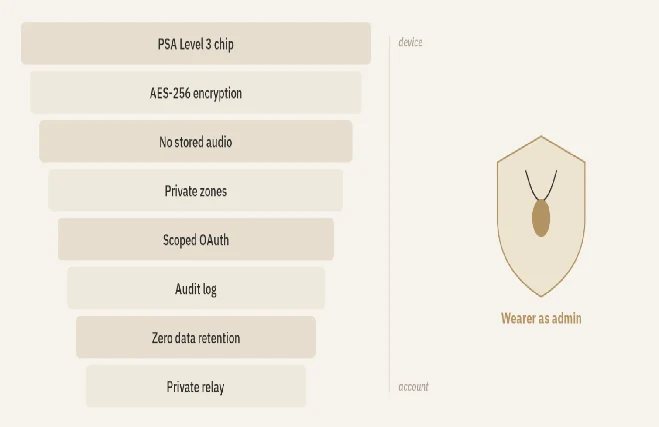
That is the only version of this product a person can wear for nine hours a day, and the only version other platforms can safely build on. Control is a product behavior, not a policy page.
How we win
Follow-through compounds. Every day adds context, every kept promise makes the next day easier, and starting over somewhere else means starting with no history.
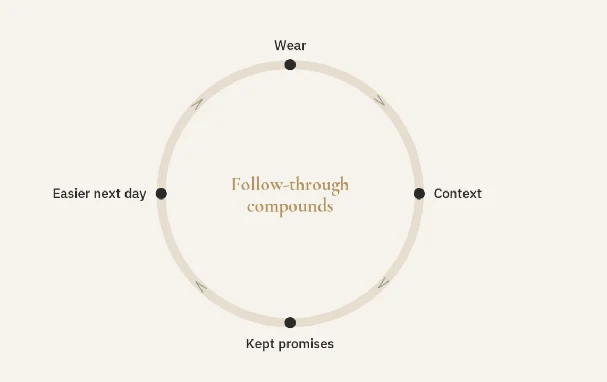
Legend is in a controlled, paid closed alpha designed to maximize our surface area for learning and retention. 170 people have paid to join the program. In the last two weeks, trusted testers have begun receiving and are wearing the device. Our strongest early users are executive women with ADHD. It is helping them remember conversations, organize what is on their mind, and notice what needs attention. Together we’re developing an assistant that can help them do the work, too: preparing next steps, checking in when a decision is yours to make, and taking things off your plate rather than adding to it.
What people are saying
“There is a level of security that this brings to me.”
“It's made me feel more secure about my conversations with people.”
“The one thing I was looking for in life was this.”
“Apart from what it can do, it’s a stunning piece of jewellery.”
Trust is the moat
Every recording technology since 1888 Kodak has faced the same fight. Society never settles whether a device can listen. It settles who is allowed to, and in which rooms. Those norms move fast: in the early 2000s, someone talking into a Bluetooth headset looked like they were talking to themselves, and within a few years no one looked twice. Even more recently we saw this with AI notetakers in professional environments.
Hardware, models and raw transcripts commoditize quickly and create no network effect on their own. What compounds is permission. It goes first to people with a real need, and to objects whose role is clear the moment they enter a room.
So Legend starts as assistive technology for people with ADHD, worn as jewelry. It stays in the boardroom, the doctor's office, and dinner at home. Each of those rooms adds lived context that can't be recreated once the moment passes. Their agents draw on it every day, they keep granting access, and it becomes part of how they work. Leaving means losing the productivity engine of their life.
A feature is easy to copy. A norm settled around a trusted object is not. This is where the platforms are structurally weak. A company that earns its money from attention, or that buys a pendant startup and shuts it down within a year, can't credibly promise a woman her private life stays hers.
We expect incumbents would rather an independent company carry this responsibility than absorb the regulatory and social backlash themselves. The controls and design decisions we make live up to that responsibility.
A team that ships
We are repeat founders building at the intersection of voice AI and consumer scale. Saba was on the founding team of Orai, an AI speech coach that reached 300,000+ users and raised $3.3M, previously led the startup pipeline at Techstars, and co-led a $8M pre-seed fund. Zach co-founded Fieldy, a hands-free wearable AI note-taker that reached $5M in annualized revenue, and was a growth hacker at NGL, which reached 300M+ installs. AK exited an award winning mobile app development studio, has sold ~$5M in luxury jewelry on Shopify with his wife and held senior roles at Google and Meta where he authored a patent and leveraged AI to drive revenue and customer growth.
All three of us have ADHD. We are building for ourselves and the community around us first.
The round
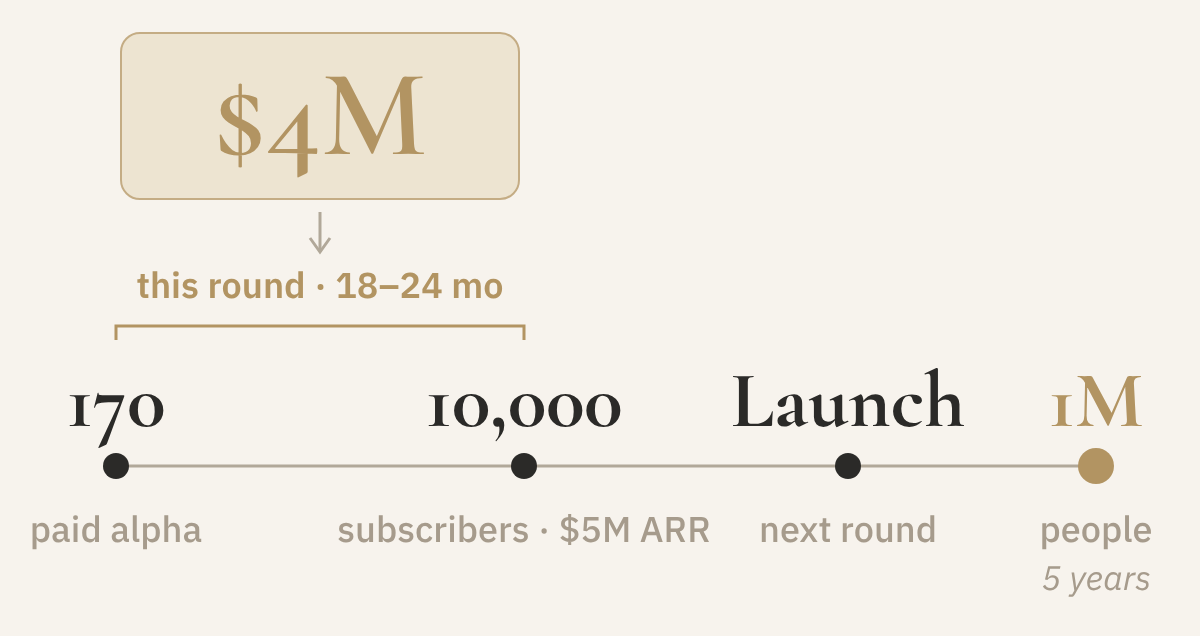
We are raising $4M to ship the next hardware batch, expand the trusted tester cohort to 10,000 paying subscribers and $5M in ARR within 18-24 months. During this time, we will prove retention through careful refinement of both hardware and software ahead of a major launch funded by the next priced round. The ambition is to get Legend into the hands of 1M people within the next 5 years.
Sources
- Song P, et al. "The prevalence of adult attention-deficit hyperactivity disorder: A global systematic review and meta-analysis." J Glob Health 2021;11:04009. pmc.ncbi.nlm.nih.gov/articles/PMC7916320
- Staley BS, et al. "ADHD Diagnosis, Treatment, and Telehealth Use in Adults (NCHS Rapid Surveys System, United States, Oct–Nov 2023)." MMWR 2024;73(40):890–895. cdc.gov/mmwr/volumes/73/wr/mm7340a1.htm
Trusted tester program
Become a trusted tester
Legend is in a controlled, paid closed alpha, built for learning and retention. 170 people have paid to join.
Our strongest early users are executive women with ADHD, for whom a dropped promise is not a minor annoyance. If you live by conversation, and you feel the loss when context slips, you are who this is for.
What you get is the Genesis Edition pendant, arriving before Christmas 2026. $499 a year. The pendant is free, usage is unlimited, and every future device is free. Legend observes your day and follows through on what matters, so nothing gets dropped. What we ask in return is simple: wear it, use it, and tell us what breaks.
We are refining hardware and software with this cohort, ahead of a major launch. Your feedback is the product work, not a testimonial we collect after the fact. What this is not: a launch, a mass sale, or an ad campaign. It is a limited, controlled cohort, and it stays controlled until retention proves the product earns a wider release.
Access code: LEGENDARY